Sunday, 29 April 2012

Austerlitz by Sebald

Pictured below are drawings mapping some examples of 19th-century fortifications. The fortifications of Antwerp are featured in Austerlitz by Sebald. In the book It is explained that each time a new ring of fortification was built around Antwerp, advances in siege techniques made them obsolete, so the Belgians had to commission further defences to proctect the obsolete ones. Unfortunately there complexity ensured that they would never be finished before they became redundant, at which point new walls would have to be constructed. The final fort stood useless until the second world war, when the Germans decided to turn it into a concentration camp. Below the images are two extracts from Austerlitz discussing the fortifications.


Tilbury Fort, Near Gravesend Kent


Fort Breendon and its outer rings,  Antwerp


"Yet, he said, it is often our mightiest projects that most obviously betray the degree of our insecurity.  The construction of fortification, for instance…clearly showed how we feel obliged to keep surrounding ourselves with defences, built in successive phases as a precaution against any incursion by enemy powers, until the idea of concentric rings making their way steadily outward comes up against its natural limits…"

"No one today…has the faintest idea of the boundless amount of theoretical writings on the building of fortifications, of the fantastic nature of the geometric, trigonometric, and logistical calculations they record…yet even from our present standpoint we can see that towards the end of the seventeenth century the star-shaped dodecagon behind trenches had finally crystallised, out of the various available systems, as the preferred ground plan: a kind of ideal typical pattern, which indeed…strikes the layman as an emblem both of absolute power and of the ingenuity the engineers put to the service of that power.  In the practice of warfare, however, the star-shaped fortresses which were being built and improved everywhere during the eighteenth century did not answer their purpose, for intent as everyone was on that pattern, it had been forgotten that the largest fortifications will naturally attract the largest enemy forces, and the more you entrench yourself the more you must remain on the defensive…The frequent result…of resorting to measures of fortification marked in general by a tendency toward paranoid elaboration was that you drew attention to your weakest point, practically inviting the enemy to attack it, not to mention the fact that as architectural plans became increasingly complex, the time it took to build them increased as well, and with it the probability that as soon as they were finished, if not before, they would have been overtaken by further developments, both in artillery and in strategic planning, which took account of the growing realisation that everything was decided in movement, not in a state of rest."


Wednesday, 25 April 2012

GEORGETOWN


Georgetown, Guyana // Georgetown, Washington DC // Georgetown, Bahamas // Georgetown, Penang // Georgetown, Tasmania 

Perth, Westen Australia // Perth, Scotland


River Tay // Swan River


Tuesday, 24 April 2012

OVER AND OVER!

Bethlehem, Pennsylvania // Bethlehem, Palestine 

Falmouth, UK // Falmouth, Jamaica

Palestine // Palestine, Texas  

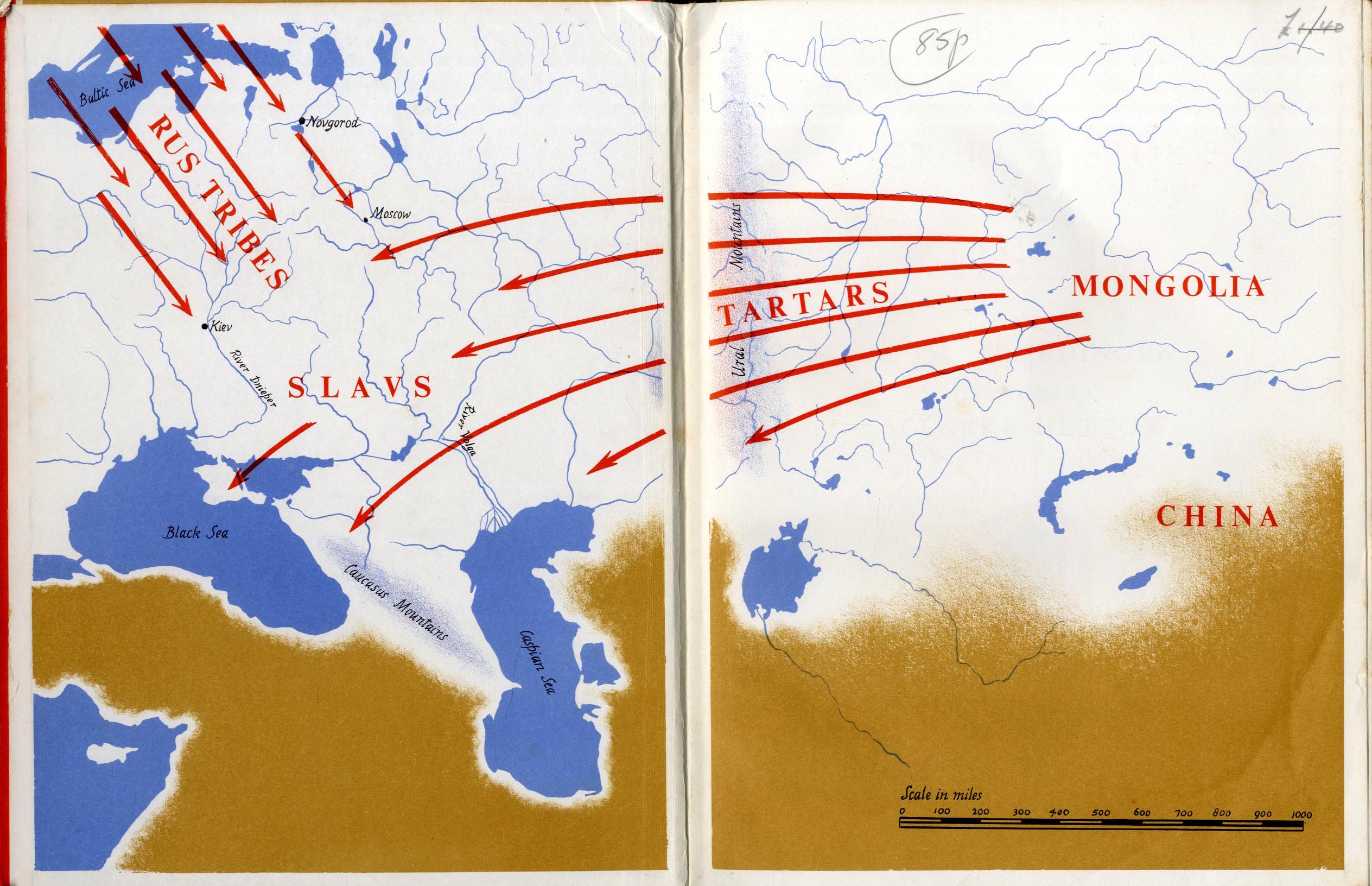
This map tells a story


Clarke Hutton endpaper map from a book of pictorial history. And here Clarke Huttons illustrations for the tale of noah and the flood

Monday, 23 April 2012

Single page narrative


Rama's Army Crosses the Ocean to Lanka - As part of the british museum's Garden and Cosmos – Royal Paintings of Jodhpur


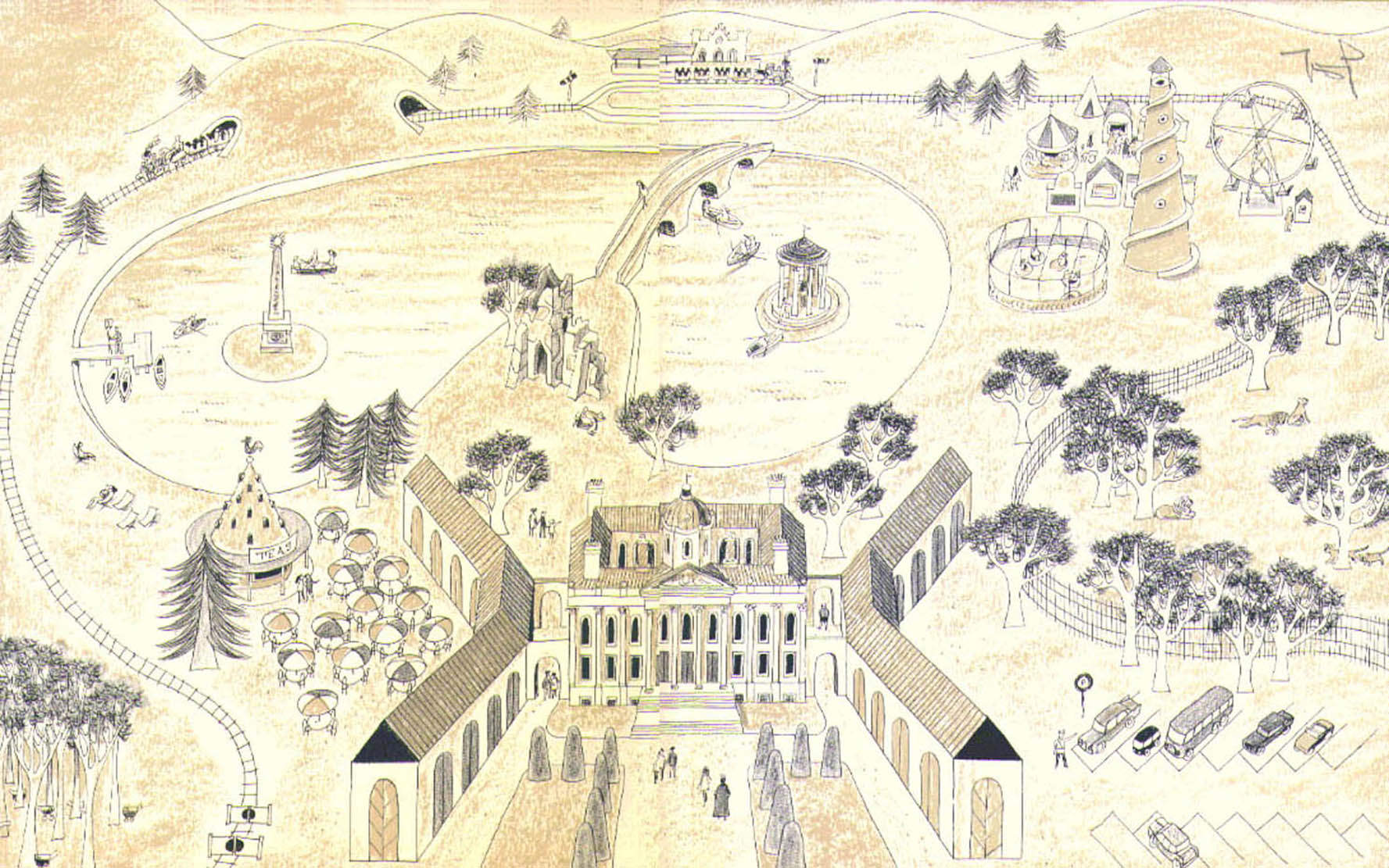
George Him/ Ann Thwaite/ The Day with the Duke. Above; Map featured on the endpaper. Is a map a single page narrative?. Below; The children are taken home.


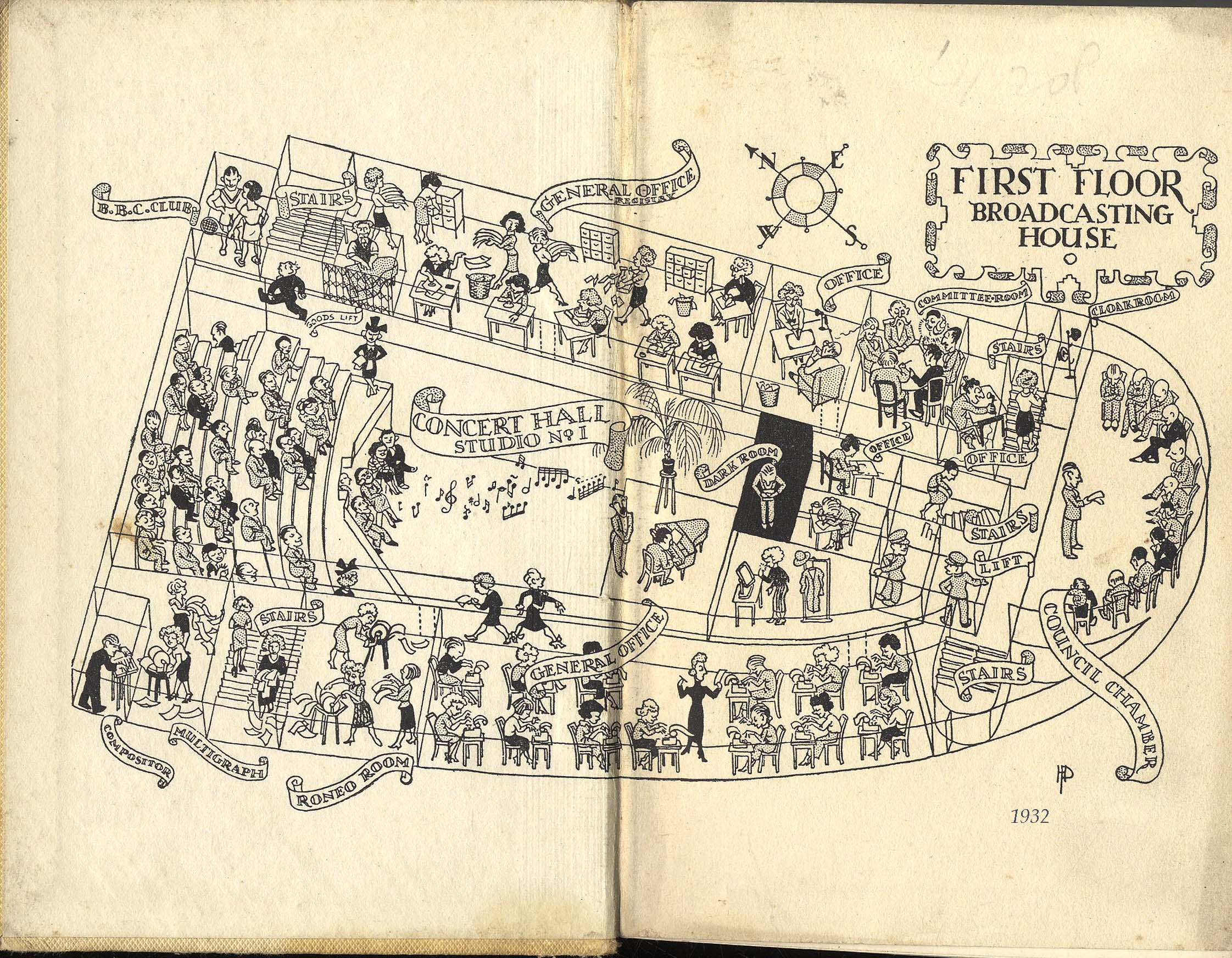
Endpaper map from the BBC YEARBOOK from 1932


Lots of interesting examples of this phenomenon on this website 

Wednesday, 18 April 2012

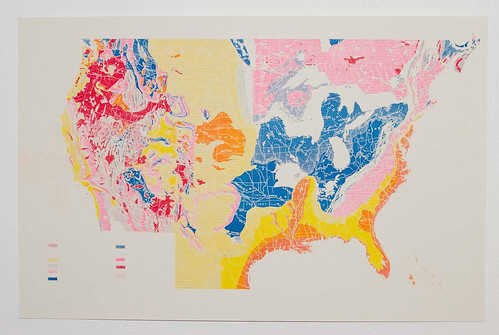
Map printed by Risograph


Risograph printing, to be considered ?

Lunar phase map

Katherine Venturelli Lunar Journey

Depiction of the lunar phases, Turkish map fold.

Tuesday, 17 April 2012

Saturday, 14 April 2012

THIS BOOK IS......

( Pictured here being built )


FINISHED! 

Tuesday, 10 April 2012

Word Snake Two

Names and dates imply a movement and progression in a chronography. 


Numbers-- known --future 
                     future--event-- unknown  

Wednesday, 4 April 2012

Jessie Garon Presley


ss


 Gladys Presley believed that Elvis's still born twin was acting as his protecting angel. “when one twin dies the one who lives get the strength of both" - she  said this  in a interview with women's weekly magazine in 1956

Success!

After the death of elvis Heniz's career went from strength to strength.


After the death of elvis Heniz's  career went from strength to strength>>> HOWEVER By 1987 his development company was running into trouble and ECD Iserlohn could no longer pay it's bills and Heinz could not find anyone who would help him in germany So Heinz turned to friends he had made in libya.  On the 4th of december 1987 ECD Iserhohn took to the ice in shirts sponsored by colonel gaddafi's green book. They lost the game. By the 5th of december 1987 ECD iserhohn where banned from the league for violating the political neutrality of the sport.
Sent using BlackBerry® from Orange

Friday, 23 March 2012

Central section of the book

ZOOM VIEW

This is the central section of my book, up until this point the narratives and images are being developed in my prototype book. The structure of this prototype book served as the constraints within which my story could evolve. At this point I am now moving on to plan the rest of the book including the ending externally from my original book, I will do this in my research journal. it will be interesting to see how this change of approach affects the evolution of my story. Hopefully it will not be too noticeable to anyone else but me. The reason I want to plan and render separately to my original prototype is because I feel this will be a more beneficial in reaching the endpoint of the story. I feel now I have understood and accepted the constraint of the form of the book it would make sense to free myself from the physical constraint of working within that tatty badly bound prototype.

Wednesday, 14 March 2012

Accordion Books


The  concertina format lends itself well to a linear open-poetic reading this is why I want to utilise this format for my project


There  are some more great examples in this brilliant blog about all things concertina;

http://www.accordionpublications.blogspot.co.uk/


The Birth of the Machine Consciousness by Jonathan Rosen 


This is The Birth of the Machine Consciousness by Jonathan Rosen A beautifully made concertina book that we have in our cabinet in the studio.  the structure of this book influenced my decisions on how to construct my final book. I really like the white on black embossed drawings on the coverings,   this is another good example of way   concertinas  lend themselves to an open poetic reading.

Tuesday, 13 March 2012

Wall Book


My wall is my sketchbook. It is an evolving sketchbook that unfortunately I failed to document much.  it serves its purpose very well for me. At the end of this project I will take all these scraps and place them in a book. this will not do justice to my constantly changing, ever useful wall book.


Today I took my wall book down. This is not a sad day,  new beginnings! ywaa.

Friday, 9 March 2012

Vilém Flusser talking about thought - transript

Untitled (Book) Philip Guston 1968
Thought is an absurd process. We think, in order to think no more, we talk, in order to stop talking. Thought is absurd, but it is what makes us what we are, thinking things, humans. To be human is to be absurd. To be human is to be expelled from the innocence of Paradise, to be expelled from integration. To be human is to be an outcast, a being in banishment, in short: a thinking absurd being. Let us accept this absurdity, let us think as much a possible, let us doubt on as many [levels] as possible. Rilke says that the foundation of our existence has expelled us, risking us. Let us accept that risk. Let us refuse to be made prisoners of the tired and boring conversation now under way in the Western civilization, that tedious conversation called “progress”. Let us not be afraid of new words and new thoughts. Let us open new openings and experience new amazements.


HA whats his problem with progress, what all the fuss. I know. I think I know.

I like this quote


Thursday, 8 March 2012

The “uncomfortableness” of the voice and text in music and art


This will be the title of my essay, I will be looking into one tiny aspect of how we use and understand language, concentrating specifically on the relationship between the recorded voice and music. I will be seeking parallels between that and the relationship between printed image and text.

My approach will be a reductive one, as I am not an audio scientist or skilled musician nor am I a language theorist. I sing and record songs and I am a drawer and printer of image and text. In my work I am interested in the way images and text are loaded with external connotations.  I like to play with these connotations; fitting pieces together in combinations of text and image in order to explore the way I read image and text.  My personal standpoint as someone who struggles with written language that at times can appear completely alien towards me but for which I have an immense enthusiasm; this is a motivating factor in the desire to incorporate language into my drawings. Maybe by adopting language I hope I can persuade myself to accept it? Or more likely I hope that it will accept me?blabllalabab!


So is it is my uncomfortable relationship to language that motivates me to seek out and define as positive a 'uncomfortableness' in the way language operates? 

I'm not going to attempt to prove any link between music and art, what I will concentrate on is a parallel “uncomfortableness" that I perceive between the ways we integrate language into these two aspects of our culture. A clunkiness  in  the way we use language as a conveyor of meaning and thought and as an element incorporated into our creative practice.

Wednesday, 7 March 2012

What came first music or language?


Which came first the hummingbird or the talking egg? Music or language? For answers to the questions of prehistory we have to look to the assertions of scientists. Charles Darwin was a scientist.

In his book "The Descent of Man and Selection in Relation to Sex" Darwin argued that there existed a 'musical protolanguage' model that existed before the use of ordered vocal patterns to convey meaningful instruction.

Hello can you understand my ordered vocal pattern?

Tuesday, 6 March 2012

Statement about my current project


Statement about my current project

To remind myself in a few paragraphs how to explain what I'm doing.

With this book I am playing with the idea of coincidences. I'm taking well-known figures Col Gaddafi, Elvis Presley and a slightly unknown ex ice hockey team owner from the 5th largest city in Germany with the intention of discovering significant coincidences in their lives and links between their stories. I chose these figures in a relatively arbitrary fashion with only two links initially in mind; a place; Germany and a date; January 8th 1935, Elvis's birthday.  

Upon further research and subsequently drawing upon the further similarities I discovered my intention was to utilise the way coincidences resonate and are understood to show a world in which actions or events can be seen as part of a larger pattern or structure. Although slightly absurdly straightforward I find this idea reassuring, every individuals life events as part of them and as part of the whole mesh in the pattern, possibly. I will key into this perceived pattern with the visual and physical structure of the finished book. There will be multiple ways of reading the book as will follow from the pattern of things and events depicted in the book. These multiple ways of viewing the pages will offer new juxtapositions between images and text when the book is extended accordion style.

My attempt is not prove anything pseudoscientific or spiritually enlightening. I am perceiving pattern in the life stories of well-known others because I'm looking for it; as if interpreting forms from patches on a wall or clouds in the sky. Pattern only exists because we attach so much significance to that which re-occurs, happens again. What I find really interesting is the way intuitively we can attach significance and read meaning to these patterns. It's funny which ones we pay attention to and which ones we don't.

The tone of the book should hang somewhere between the absurd and something resonates slightly meaningfully. Hopefully.


Monday, 5 March 2012

Rejected figures for book

The Pope, NiccolĂ² Machiavelli and Paul Kammerer were all initially considered for my developing narrative but they have all now been rejected, I think it is important to note this at this time.

Friday, 2 March 2012

Language is a virus from outer space


Language is a virus from outer space said William Burroughs but who said;

Writing about music is like dancing about architecture.


this website with bright green text on a black background does not know for my upcoming essay i will be writing about music ( and image and thought) here is a quote and some thoughts;;;


"the gesture of piano playing is not, in fact, totally alien to writing. It is, like writing, a linear gesture, although the lines it produces are composed of acoustic vibrations, not of letters. It may therefore be held that if we type we still engrave (at least as far as the intention of our gesture is concerned), and that the ‘piano quality’ of our gesture stresses this fact: we no longer engrave with a stick, but with a series of hammers."

- Flusser on writing

Maybe it would be good to start by drawing comparisons between the action of typing from its origins as an action that operated hammers that "impressed text upon sheets of paper" in drawing comparisons between this and the act of playing the piano; maybe here the way the piano is a device that impersonates the voice in the same way the typewriter is a device that impersonates the act gesture of writing physical writing."


Possibly taking the quote above in mind that the relationship between the voice and the piano the musical instrument has similarities between that of the spoken word and the act of engraving letters. The piano as a reductive tool that takes the sound of the voice converted into musical notes fire a series of hammers possibly I could draw comparison with the typewriter as a device that takes the meaning of the voice and converts it into symbols via again a series of hammers.

Thursday, 1 March 2012

Contemporary Illustration

I fear contemporay illustration. Here is a list of contemporay illustrators;

Luke best

Tom Gauld

Adam Simson

Laura Carlin

I'm not sure what constitutes contemporary illustration. I think i may be thinking about the marketplace.

Here is a typographer;

David Pearson is giving a talk as part of our MA lecture series His work is really clean.


Wednesday, 29 February 2012

One Of The Good Guys


Interesting idea from Robert Fisk which could make a useful point in my narrative, "You can't blame Gaddafi for thinking he was one of the good guys" The book should take in language from external sources and re-mould to highlight and create new ideas and meaning. I like using words from song and news media and etc.., appropriating such media can serve to fortifie.

Thursday, 16 February 2012


Machiavelli could be an interesting figure for my next project

Monday, 30 January 2012

Word Snake Number 1


coincidence --- uncanny --- mysterious, --- weird 


Friday, 27 January 2012

The bad-tempered Beelzebufo, or "devil frog,"

Not the midwife toad but an image that came to mind when reading the case of the midwife toad. In fact this is an image that i can't forget,  Its an illustrated size comparison for a story about a large extinct frog. But when I first saw it I didn't know that.


  • Who's pencil is that?
  • Why is one big and the other is small?
  • Why is he looking at me?


I could of been thinking these things, but I don't think I was thinking at all.

Maybe thats why this image has stayed with me, an unintentional uncanny apparition, sliped in when I was thinking about something other.


Wednesday, 25 January 2012

The Law of the Series By Paul Kammerer

Das Gesetz der Serie (The Law of the Series) Paul Kammerer

Never translated into english, Kammerer recounts about 100 anecdotes of coincidences that had led him to formulate his theory of Seriality. He claimed through these coincidences, lies the key to the way the world is structured. These are not just coincidences, but evidence of "The Law of the Series." Kammerer wanted to prove that a universal law of nature that acts independently of known physical principles of consequence manifests itself in what are perceived as "coincidences"

The book contains slightly uncanny anecdotes such as:

"Two soldiers, both 19 years old, both born in Silesia, both volunteers in the transport corps, both admitted to the same hospital in 1915, both victims of pneumonia, and both named Franz Richter

And others not so uncanny such as:

"I went to the theater and was placed in the 8th row of the stalls, the next day I went to the music hall and was placed on the 8th row of the stalls" ( Badly Translated, truncated )

"On 17 May 1917 we were invited to the Preview a new opera. Along the way to the Schreker's house, in the front of the Train station, I bought chocolate candy for me and my wife. Later Schreker himself played us an excerpt from his new opera, the main female role is CARLOTTA. Eventually when we came home I emptied my pockets and realised that the bag of candy had carried the inscription CARLOTTA"

Midwife Toad

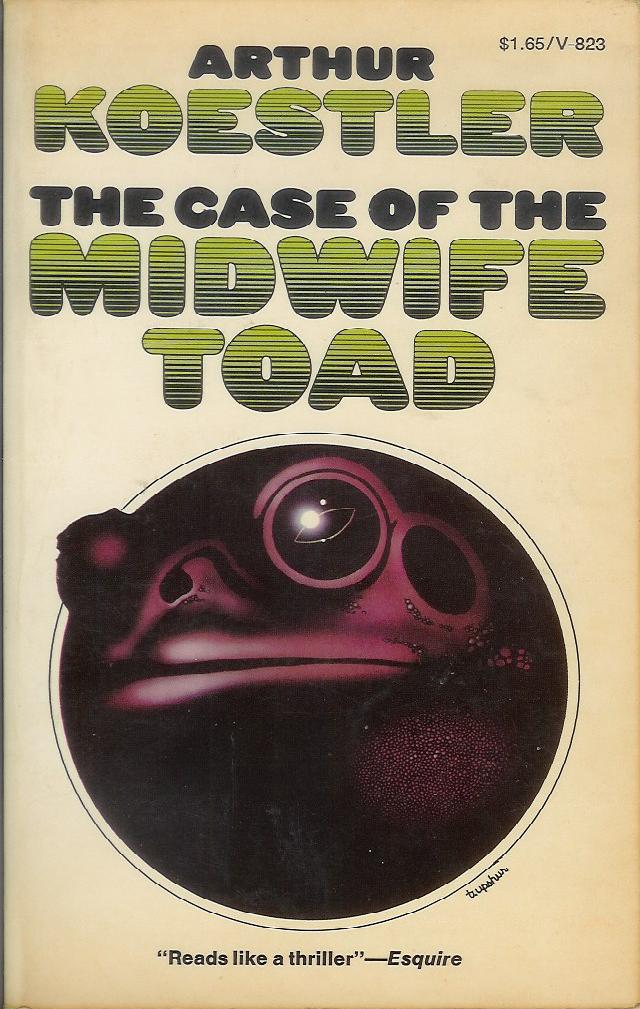
In august 1926 Kammerer was accused by a british science journal of fraudulently doctoring lab results by injecting ink into the skin of toads. Even before this point his work was controversial and divisive amongst biologists leading some to suggest he may of been framed. There is an account of all this in 'The Case of The Midwife Toad' by Arthur Koestler which has a very nice cover

In September 1926 Kammerer walked up a Austrian mountain and shot himself in the head. One of his pockets contained a letter addressed "to the person who finds my body'. It read:


He added a postscript requesting that his wife not wear black or show any other signs of mourning


Tuesday, 24 January 2012

Palestine in Texas


Columbia Debris fall over Palestine Texas

http://www.isjl.org/history/archive/tx/palenstine.html

Ilan Ramon's body and belongings scattered over palestine, texas

Coincidence sparks theorising all over internet

Propergated;
  • Divine justice for past?
  • Omen for future?

Some overtly antisemitic some, some less so.

Such as;

"The brilliant Christian "explorer of inner space" Carl Jung wrote of synchronicities in the lives of human beings and of the "collective unconscious". Synchronicities, according to Jung, are those pesky little "meaningful coincidences" that often occur during times of crisis. Perhaps the "meaningful coincidence" involving the Jewish astronaut and Palestine, Texas is a way of God talking to us."

SO All events, not just the uncanny or those characterised by coincidences, can be seen as questions
and the response seems to be to offer answers. These can be published with the click of a mouse!

The internet is the bigest book.


But what If you do not take these events as questions that require interpretation?


Especially those with uncanny characteristics


What if you would take them as:

  • Beats of a drum?
  • Un-utterable messages with no meanings?
  • Hiccups of history?
  • Collective subconscious engineering?
  • Cosmic trap streets? 
  •  ha ha's

Time traveling mouse


 Coincidence? Or a time travelling mouse?

  Is It in their nature for drawings to travel in time?

Monday, 23 January 2012

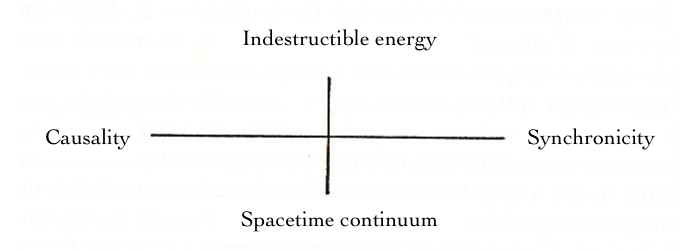
Carl Gustav Jung's theory of coincidence


Diagram illustrating concept of synchronicity by CG Jung.


“Synchronicity is the experience of two or more events that are apparently causally unrelated occurring together in a meaningful manner.”  Jung coined the word to describe what he called “temporally coincident occurrences of acausal events.” Jung variously described synchronicity as an “acausal connecting principle,” “meaningful coincidence” and “acausal parallelism.”

I have now read up on jung's  theory of synchronicity ....it will  not  overtly impact the way I make my book.... but is is useful to be aware of it.

Friday, 20 January 2012

BOOK as STORY DEVICE in BOOK


A Scientific Search For The Face of Jesus 1972

"I gave Elvis this book about the Holy Shroud of Turin to Elvis several hours before he died. When he was found later that day, the book was clutched to his chest." - Larry Geller

( Elvis Died, August 16, 1977 )

Larry Geller born August 8, 1939 in Elmira, New York  celebrity hairstylist and author. Larry discibed himself as Elvis personal hairstylist, spiritual mentor and confidant.

Elvis Presley joined the 3rd Armoured Division in Friedberg, Germany, on October 1 1960

The distance between Friedberg and Iserlohn is about 138.322 km

Johann Valentin Pressler, a winegrower from Niederhochstadt, migrated to the America in 1710. Durring the civil war the family changed the name to Presley, and that branch of the family eventually produced a son named Elvis.

Niederhochstadt became Hochstadt sometime during the 250 years after Johann Pressler left it. In 1959 Elvis would drive his Staff Sergeant to and from the base in Grafenwohr traveling through the town of Hochstadt; Elvis was passing by within yards of his fathers ancestors who still lived in Hochsatdt and still grew wine groves.

The distance between Iserlohn and Hochstadt an der Aisch is about 287.949 km
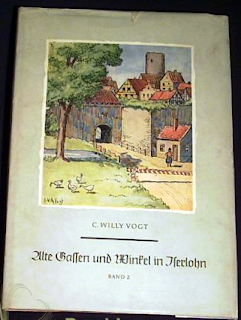


Alte Gassen und Winkel in Iserlohn Band 2  Ancient streets and angles in Iserlohn, Volume 2. Hardcover (1956)


The Shirt


The Book


Das GrĂ¼ne Buch 

German Translation of The Green Book by Muammar Gaddafi published in 1975.....


Heinz Weifenbach, with book in hand, meets Gaddafi

Heinz Weifenbach owned a Ice Hockey club, ECD Iserlohn. The club had been rumoured to be in financial trouble for some time and was avoiding tax by making under-hand payments to players. A number of players had  been investigated by the German tax department just for this reason.  At the time, the club was reported to owe the tax department US$3.4 million.

Eventually the club was on the verge of insolvency; Weifenbach declared that there was no need to panic as he had a found a new sponsor who was willing to support the club with ten million Deutsche Mark. The sponsor turned out to be the organisation marketing Gaddafi's Green Book, the Center for the Studies and Researches of the Green Book, and ECD Iserlohn, on the 4 December 1987, took to the ice against SB Rosenheim with the image of the Green Book emblazoned on its shirts.

The German Ice hockey League reacted promptly, banning the club from using the Green Book as a shirt sponsor. For the following game, the club returned without sponsorship. It was also their last game as afterwards the administrators deregistered it from competition.

Weifenbach Couldn't undersatnd this he saw Gaddafi as a "writer" and declared "The whole thing to be a apolitical issue". The West German Government did not agree, Interior Minister Friedrich Zimmermann stating: "What looked at first like a Halloween joke, is a blatant violation of the political neutrality of the sport."adding "the sport" should not support "criminal elements and terrorism."

in 1969 Zimmermann was quoted "Nonviolent resistance is violence . " - in front of the Border Guard Command Center Peter Kohler: The best quotes from politicians, Baden-Baden 2005, p. 131  He repeated this again in 1983 in regards to organised sit-in’s protesting against the deployment of nuclear missiles in the US military base in Mutlangen stating “the so-called non-violent resistance of a sit-down protest is illegal and criminal violence”

Between 1965 and 1983, with a few gaps, the Federal Armed Forces trained Libyan soldiers, while Libyan police officers attended courses arranged by the Federal Criminal Police Office.

In 1960 Zimmermann was accused of perjury in connection with a corruption case involving Bavarian casinos bribing and blackmailing state officials. He was acquitted in 1961 based on a medical report that stated at the time of the oath Zimmermann mental capacity was diminished due to hypoglycaemia.

Back in 1988 Weifenbach continued his fight for the club's survival, organising a flight to Libya for himself and 25 journalists to meet Muammar Gaddafi. Gaddafi signed copies of the Green Book for the visitors but apparently knew very little about the deal, asking, according to one of the accompaying journalists, "What is the name of this tennis club I am sponsoring?".

Before his demise Weifenbach managed to upset the authorities one more time: the tycoon made an advertising deal with the state owned Deutsche Post, e for 5000 Deutsche post vans carry advertisements for a "new publisher - an answer for a better life". The only published product of this new publisher was Colonel Gaddafi's "Green Book".

Heinz Weifenbach was eventually sentenced to 27 months in prison for tax evasion.

This is the most information you will find anywhere on Heinz Weifenbach on the internet in English. Fact.

Tuesday, 20 December 2011

Blurted Ideas For Book

Blurted idea number 1

Minibus coincidence. a man possibly, some sort of official, is being showen  around number of locations say in Austria?,  Holland?, Poundland in England?, the last point before he departs he sees a red door in a building. He gets on the minibus, to the airport. He departs will stop maybe something happens on the aeroplane?. He arrives in China gets in a minibus.  He gets out of the minibus, he sees the same building in the same red door, story hinges on this point. He thinks about it the same building in 2 different locations the differences and similarities. It turns out he's in a recreation in China of the place he departed. Minibus was a Chinese re-creation of Ford transit?  some other type of minibus ? But with the Chinese name. Maybe not any point with that.

Story could  then show, the 2 locations from his memory with overlaps  drawn on transparent pages. Same device can be used for other  coincidences.

Blurted idea number 2

Coincidences mesh flow-through structure of book eeriness is doubted by narrator? Possibly a character doubting  any supernatural element. Proof is required of unidentified cosmic coincidence force? , unidentified force in general, maybe. Proof is given at or near conclusion of book in the form the fake book compartment housing  Book inside book. This internal book will, confirm   eeriness  if opened out the right stage. Book will curse viewer if opened at the wrong stage.

 Not sure how to do this. perhaps there will be  2 dreams, maybe towards the beginning  or somewhere else in the book. If you were to open the book inside the book at the wrong stage you would confirm dream number 1 the book inside the book would inform you of this.  if you have however open the book at the right stage then dream number 2 would be confirmed.

Or maybe it would just be a case of the dream coming true or not coming true, or the reader being cursed with the dream happening to them  as per the type of events witnessed in the narrative. The uncanny could leave the book and enter into the real world of the viewer.


Saturday, 10 December 2011

A Selection from Selections from the Works of Fourier....

This is Charles Fourier's thoughts on the arrangement of labour I really like the lists that he writes like this one and very much this one. I also hope that I would be able to prove my "integrity and ability" but worry I might not.....

IN THE CIVILIZED MECHANISM we find everywhere composite unhappiness instead of composite charm. Let us judge of it by the case of labour. It is, says the Scripture very justly, a punishment of man: Adam and his issue are condemned to earn their bread by the sweat of their brow. That, already, is an affliction; but this labour, this ungrateful labour upon which depends the earning of our miserable bread, we cannot even get it! A labourer lacks the labour upon which his maintenance depends- he asks in vain for a tribulation! He suffers a second, that of obtaining work at times whose fruit is his master's and not his, or of being employed in duties to which he is entirely unaccustomed . . . I The civilized labourer suffers a third affliction through the maladies with which he Is generally stricken by the excess oflabour demanded by his master . . . He suffers a fifth affliction, that of being despised and treated as a beggar because he lacks those necessaries which he consents to purchase by the anguish of repugnant labour. He suffers, finally, a sixth affliction, in that he will obtain neither advancement nor sufficient wages, and that to the vexation of present suffering is added the perspective of future suffering, and of being sent to the gallows should he demand that labour which he may lack tomorrow . . . labour, nevertheless, forms the delight of various creatures, such as beavers, bees, wasps, ants, which are entirely at liberty to prefer inertia: but God has provided them with a social mechanism which attracts to industry, and causes happiness to be found in industry. Why should he not have accorded us the same favour as these animals? What a difference between their industrial condition and ours! A Russian, an Algerian, work from fear of the lash or the bastinado; an Englishman, a Frenchman, from fear of the famine which stalks close to his poor household; the Greeks and the Romans, whose freedom has been vaunted to us, worked as slaves, and from fear of punishment, like the negroes in the colonies today. Associative labour, in order to exert a strong attraction upon people, will have to differ in every particular from the repulsive conditions which render it so odious in the existing state of things. It is necessary, in order that it become attractive, that associative labour fulfil the following seven conditions:


  • That every labourer be a partner, remunerated by dividends and not by wages

  • That every one, man, woman, or child, be remunerated in proportion to the three faculties, capital, labour, and talent.

  • That the industrial sessions be varied about eight times a day, it being impossible to sustain enthusiasm longer than an hour and a half or two hours in the exercise of agricultural or manufacturing labour.

  • That they be carried on by bands of friends, united spontaneously, interested and stimulated by very active rivalries.

  • That the workshops and husbandry offer the labourer the allurements of elegance and cleanliness.

  • That the division of labour be carried to the last degree, so that each sex and age may devote itself to duties that are suited to it.

  • That in this distribution, each one, man, woman, or child, be In full enjoyment of the right to labour or the right to engage in such branch of labour as they may please to select, provided they give proof of integrity and ability.

  • Finally, that, in this new order, people possess a guarantee of well-being, of a minimum sufficient for the present and the future, and that this guarantee free them from all uneasiness concerning themselves and their families . . .


I n order to attain happiness, it is necessary to introduce it into the labours which engage the greater part of our lives. Life is a long torment to one who pursues occupations without attraction. - 

I AM NOT HERE TO WRITE, BUT TO BE MAD!


Robert Walser's handwriting

Thursday, 8 December 2011

Lists of texts as untill this point

In both my research journal and my online blog I have acquired and attributed images and text from these sources;

'Cartographies of Time: A History of the Timeline' Daniel Rosenberg, Anthony Grafton


'Dreamers' 'Ted Hughes


'Slaughterhouse Five' Kurt Vonnegut


'Design as Art' Bruno Munari


'Who is There? Open the Door!' Bruno Munari


'Air Made Visible; A Visual Reader on Bruno Munari' Claude Lichtenstein, Alfredo Haberli


'The Circus In The Mist' Bruno Munari


'Underwater' Chester Brown


'The Analytical Language of John Wilkins' Jorge Luis Borges


'HERE' Richard McGuire


'A Manifesto for Performative Research' Brad Haseman


'On Illustration' Andrzej Klimowski


'Leviathan' Peter Blegvad

Sunday, 4 December 2011

The Celestial Emporium of Benevolent Knowledge

WITHIN WHICH  animals are divided into:

  • those that belong to the Emperor, 
  • embalmed ones, 
  • those that are trained, 
  • suckling pigs, 
  • mermaids, 
  • fabulous ones, 
  • stray dogs, 
  • those included in the present classification, 
  • those that tremble as if they were mad, 
  • innumerable ones, 
  • those drawn with a very fine camelhair brush, 
  • others, 
  • those that have just broken a flower vase, 
  • those that from a long way off look like flies.


From The Analytical Language of John Wilkins by Jorge Luis Borges

Thursday, 1 December 2011

Charity

I donated this image and others to be projected on the outside of the Design Museum as per the wishes of this odd competition. It is a picture of what I know and feel of Christmas as of December the 1st. Maybe that's why its got two S's or maybe that's because I can't spell.


They didn't want it!


ANYWAY I have started reading Bruno Munari's book 'Design as Art'/ The book begins with the idea that most art historically was "commercial" art. : "art for art's sake" is a modern invention that doesn't match history. So from this Design is the art of our time ( Well that time the book was first published in 1966 ) this idea comes and that's where I'm at.

Here is some quotes;


'For years and years architects and designers all over the world have been designing thousands of chairs, upright chairs and armchairs, all different and all the fruit of infinite inventiveness. I have even designed two or three myself. But it seems that the problem has not yet been altogether solved, because architects and designers all over the world are still going on designing chairs, just as if all their efforts up till now had been wrong.'

'In one shop I see a brass boot, size 25 (approx.). ‘I’ll have a pair of those,’ I say. ‘We have only one, sir.’ ‘What can I do with one boot?’ ‘It is not a boot to wear on the foot, sir. It is a boot to keep umbrellas in,’ the assistant explains, smiling patiently as one would at a madman. I am greatly embarrassed by this gaffe, and leave the shop at once, nearly tripping over a marble cat decorated with floral reliefs and serving as a doorstop. I am beginning to learn.' 'These are certainly not objects produced by designers, for designers do not have such raging imaginations. They confine themselves to making candlesticks that look like candlesticks'

And finally...........


NOSTRADAMO 4) Bruno Munari PROJECTIONS WITH POLARIZED LIGHT 


'In the Home of the Future people will be able to keep a small box containing hundreds of ‘pictures’ for projection.'